
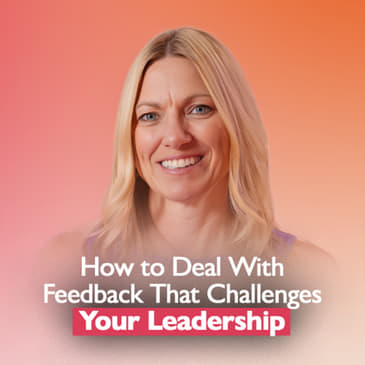

[00:00:00] Elon Musk says, move fast and break things. You know what? You think that you're this inspiring CEO, that you're this disruptive CEO, but really you know what you are? You're erratic. Pressure, unpalatable pressure. My vision was becoming chaos and my confidence was maybe becoming a little bit too much of an ego. And he said probably the most powerful thing he said to me in our 17 years of marriage, and that is take what's true about the feedback and let the rest of the day.
[00:00:30] And that I wanted to be an unflappable leader, cool, calm, and collected. Feedback that hurts is usually pointing at something that matters. All of that is the foundation of trust. And my new book, Talk With Trust, goes into this. It's a deep exploration of this exact skill. It is not abstract leadership theory, but lived experiences where feedback absolutely shaped who I've become as a leader.
[00:00:57] Hi, and welcome to the Reflect Forward podcast. I'm your host, Kerry Siggins, and I'm so glad you are here today. So about six or seven years ago, I received the toughest feedback I've ever gotten in my life. I was talking to my equivalent of a COO at the time, and we were discussing his role in the company and how we were going to move forward, how we were growing the organization.
[00:01:20] I had been on the road a ton, traveling, visiting customers, really driving the industry forward. And he was here at our headquarters making sure that all the operations that were running smoothly. And I didn't realize there was this quiet resentment that was building until it burst out. And we were having a tough conversation. It wasn't emotionally charged. And I could see that he was getting more and more upset.
[00:01:43] And all of a sudden, he burst out. And he said, you know what, you think that you're this inspiring CEO, that you're this disruptive CEO, but really, you know what you are, you're erratic. You drive and you drive and you drive and you move so fast, that you don't realize that you're leaving people behind. You think I'm the problem, but I'm not. You're the problem. You're hard to work for.
[00:02:07] I was absolutely stunned. I could not believe that my right hand man thought these things about me. And it really hit me hard for two different reasons. The first one had to do with my identity, because I believed that I was a strong, visionary, disruptive CEO. And this statement absolutely challenged what I believed about myself.
[00:02:35] But it also poked at my wound. I have this wound of I'm not good enough. Therefore, I constantly have to prove myself. I constantly have to perform. And so his feedback both challenged my identity and then reinforced this narrative that I had in my head that I was not good enough.
[00:02:58] And these moments are so incredibly intense because the question comes into your mind. What happens when the way that I see myself is not the way others experience me when that does not match?
[00:03:12] And that is what this moment did. We were in this office right here and you could cut the air with a knife. It was so incredibly tense. I was trying hard not to shake and to cry because I was so shocked.
[00:03:28] And my immediate response was to defend myself was to tell him to get the F out of my office and not to come back. But I knew that that wasn't the appropriate response because one, I believe in feedback. I believe in having difficult conversations and I believe in not reacting in the moment.
[00:03:46] And so I took a deep breath and I said, thank you for that feedback. That is a lot to process. I'm going to need to take some time and really think about what you just said. And so let's circle back tomorrow. And so he left my office and I gathered my things and got out of the office as fast as I could so that I could go and collapse. And that is what happened.
[00:04:09] As soon as I got home, I broke down and I cried. And it really was coming from this place of fear, not from the words of I made mistakes because I've made mistakes and I have no problem admitting my mistakes. But it was more along the lines of what if I am the problem? And that was the identity threat. And I absolutely wanted to armor up. I wanted to protect myself.
[00:04:35] And I also, at the same time, wanted to spiral. And that's what most of us do. We either armor up and spiral or we do both of them at the same time. But what I did know is I deeply cared. I deeply cared because I care about running a company. I care about being a great leader. I care deeply about feedback and living the ownership mindset.
[00:05:00] And this is a gift and it's also a risk because it can feel so painful. And this moment, it did not come out of nowhere. This moment of really hard feedback. In fact, the feedback wasn't even about the feedback. It was more about me. This moment happened because of my pattern to drive things forward, because of my intensity, because I constantly push for results.
[00:05:28] And that can absolutely drift into unpredictability. And that is what he was trying to tell me, even though he used trigger words and did it in a way that was incredibly hurtful and incredibly damaging. But that was the reality. My drive, intensity and pushing for results was drifting into unpredictability. And this is what happens when you lean too far into your strengths, because I absolutely am a disruptive CEO.
[00:05:58] I do move really fast. I keep a crazy pace and I have the capacity to do so much work. But I wasn't really examining it. I wasn't examining what it was doing to me and what it was doing to my team. And that's where the distortion started to come into play, because I thought I was doing the right thing. I thought I was doing right as a CEO, right? As Elon Musk says, move fast and break things.
[00:06:24] But what was happening is that my drive was becoming pressure, unpalatable pressure. My vision was becoming chaos. And my confidence was maybe becoming a little bit too much of an ego. And this is a universal leadership pattern that many of us high performing, high achieving leaders face.
[00:06:45] We are rewarded for the very behavior that creates this kind of friction, that creates this type of moment where feedback can feel so explosive on. You're driving me crazy, which is basically what he was trying to say. So I'm now at my house and I'm crying. And my husband at the time walks in and asks me what's going on. And I told him everything that had happened.
[00:07:14] And he said probably the most powerful thing he said to me in our 17 years of marriage. And that is, take what's true about the feedback and let the rest go. Now, if we're honest with ourselves, we usually do the opposite of that. We either reject the feedback because we want to armor up and protect and defend, or we internalize all of it and spiral and just talk down to ourselves about how worthlessly we are, which is what I did.
[00:07:43] I told him, I'm not cut out to be a CEO. If this is what my team thinks about me, what am I doing here? I'm terrible at this. I was spiraling. But here's the thing. Both forms of this, whether we reject the feedback or we internalize and spiral, are forms of avoidance. And this is where the real leadership skill comes in because we have to be discerning. And we have to be even more discerning under emotional pressure.
[00:08:09] And so the question that I had to ask myself, that I had to face, is what if this is true? Hell, what if all of this is true? And I had to sit in the discomfort of examining this feedback because my natural tendency is to rush it. I want to feel good, so let's just push through it as fast as possible and go fix it or go defend myself. But it was so clear I had two paths at this moment.
[00:08:36] I could either protect my ego or I could evolve my leadership. And this is where most people exit. They cannot tolerate the ambiguity long enough to grow. And that's not me. I'm here to grow. I'm here to evolve. And I'm here to learn. And so choosing the right path was so pivotal for me. Because if I would have dismissed it, it would have been blaming the person who gave me the feedback. It would have been rationalizing my behavior. This is just what good CEOs do.
[00:09:06] And I would have doubled down on my intensity. Right? This is how we're winning. Look at how we're growing the company. Obviously, something is working. But I didn't choose that path. I chose to slow down and pick one thing to work on. And that was the word erratic. And the reason why I chose erratic is not just because it's very visceral and it pokes at that wound. Right? I don't want to be an erratic person. That is unpredictable. That isn't a person who people want to lead.
[00:09:35] But I also chose it for some other reasons. I chose it because it was specific enough to act on, but broad enough to reflect a pattern. And that is what makes feedback so useful. It is when you can translate it into something that is operational. And for me, yeah, I could see how people would think I was unpredictable. I've been accused of chasing shiny objects, which I hate that term because it makes me sound ditzy and I am not. And I move fast and I'm willing to change my mind and change direction.
[00:10:04] And so, yeah, the word erratic, yeah, I could see how people could equate some of my behavior to that, even though that was not what I wanted. So now I could take this word erratic, this feeling erratic, this perception of erratic, and turn it into something actionable. So how did I do that? How did I turn erratic into my new leadership standard? Well, I decided that I never wanted to be called erratic again and that I wanted to be an unflappable leader. Cool, calm, and collected. That was my new mantra.
[00:10:34] Cool, calm, and collected. Everything was cool, calm, and collected. And I knew that it had to be more than just an intention. I had to change my behavior. I had to be very conscious of the way I was showing up. And so I started taking three deep breaths before every single meeting. In fact, today, still today, any meeting I run, we have three deep breaths to calm everybody because everybody's rushing around trying to get from meeting to meeting, those back-to-back meeting days.
[00:11:02] And it is amazing what three deep breaths can do to just ground you in the moment and to make any moment feel less chaotic, less erratic. And I was very conscious about how I showed up in meetings. Was I rushing through a conversation? Was I giving my input too soon? Was I communicating in a passionate, aggressive way?
[00:11:27] Was I showing up calm when things were going wrong, when people brought mistakes to me? Was I helping calm everybody else down or was I amplifying the problem? I had to really think about my behavior. And I gave my executive team permission to hold me accountable. I said, if I am not showing up cool, calm, and collected, please say, hey, KP, cool, calm, and collected. And that is when the real shift started to happen.
[00:11:52] Because it was not just this internal commitment I made to myself, but it's because I put this external reinforcement in place. The three deep breaths, grounding myself, asking for feedback on how people were experiencing me, giving my team permission to give me feedback when I wasn't acting cool, calm, and collected. It was so incredibly powerful. And I am such a much better leader because of it. And there are so many ownership moments in this.
[00:12:20] But the one that I really want to hit home is that feedback may not always be entirely right, but it is also not entirely wrong. And that is where the power of the ownership mindset comes in. Because there's always something to own in a piece of feedback. Even if it doesn't feel true, even if it isn't true, it's still somebody's perception of you. And there's work to do on building that relationship.
[00:12:45] And your responsibility is not to agree with the feedback, but your responsibility is to examine it. Feedback is data. It's information. And your job is to decide what to do with it. And the leadership maturity is measured in how you process hard truths, not in how you avoid them. So as I wrap up the podcast today, I'd like to leave you with the key takeaways. Number one, feedback that hurts is usually pointing at something that matters. Something that needs to be examined.
[00:13:15] There is always some form of truth. Always some way to own something in any piece of feedback you get. Number two, you don't have to accept all feedback, but you must be willing to examine it. That is how you evolve and grow as a leader. Number three, strengths become liabilities when left unchecked. That is absolutely what happened to me. I was driving hard. I was moving fast. I was changing direction too often.
[00:13:42] And while that absolutely did help drive the company, there was collateral damage. And that was the liability that came up in this piece of feedback. So worth examining how your strengths are becoming liabilities. Number four, transformation happens when feedback is translated into behavior, not just insight. It's great that you have awareness, but it doesn't matter if you do not change your behavior.
[00:14:09] And then finally, number five, the best leaders build systems of accountability around their growth, not just intentions. Your intentions matter. But what matters even more is that you're doing something about it and you have to have a system of accountability to be able to make those behavior changes. Right? My three deep breaths. My asking people how they're experiencing me. Me giving permission to people to give me feedback on my cool, calm, and collected journey.
[00:14:37] And when you do these things, it is amazing how much better your life can get, even if it's really painful in the moment, just like that one was for me. So circling back to this moment in the office, even though it was a very visceral moment, very emotional, one that is burned in my memory forever, that moment was not a one-time lesson. It became the foundation for how I lead and how I think about trust.
[00:15:01] Because trust is at the root of all communication, whether it's a communication breakdown or communication that is going really well. I've thought long and hard about all those moments building up to that emotional outburst, all those times where this person didn't tell me what he was thinking, didn't give me feedback, and it built and it built until it exploded out and damaged our relationship.
[00:15:25] I think about all of the times that I didn't build trust because I was moving too fast and not creating moments to slow down and not creating those moments where people could give me feedback. And I think about how feedback is delivered. It was delivered so poorly that even though it was so good that the truth came out, there was no way to recover from it.
[00:15:49] And why being prepared and being calm and having all of your facts and your feelings ready so that you can deliver feedback in a way that lands, that builds a relationship that's helpful, is so incredibly important. All of that is the foundation of trust. And my new book, Talk with Trust, goes into this. It's a deep exploration of this exact skill.
[00:16:13] It is not abstract leadership theory, but lived experiences where feedback absolutely shaped who I've become as a leader. And if this moment resonates with you, the book goes further into the conversations that we leaders are avoiding, but we know we need to have. And this story opens the book and it sets the tone for everything that follows.
[00:16:37] And as I leave you today, I'd love for you to sit with this question because every single one of us has an answer to it. What feedback are you avoiding that could change who you are becoming as a leader? With that, I will leave you to your day. If you think someone could benefit from this episode, please feel free to share it. And if you haven't, hop on over to YouTube or your favorite podcast platform and subscribe to the Reflect Forward podcast. Share it with a friend. Write a review. Send me a comment or a DM.
[00:17:06] I always appreciate hearing from you. Take care and we'll see you at the next episode. a