
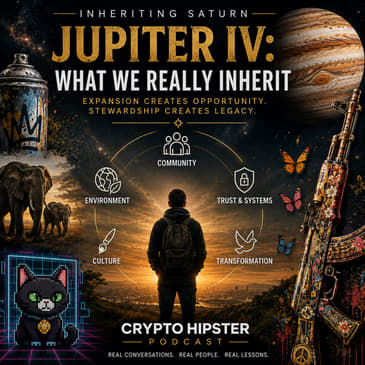

Jupiter IV: What We Really Inherit
What happens when something you create becomes larger than you?
In this solo episode of the Crypto Hipster Podcast, Jamil Hasan continues his journey through Inheriting Saturn by revisiting four conversations from the podcast archive—conversations that once seemed to be about NFTs, art, technology, and innovation.
Five years later, they sound very different.
A graffiti artist discovers that creativity can become responsibility. A conservation entrepreneur realizes that protecting wildlife means protecting the habitat that allows it to survive. An artist and founder builds technology designed to deserve trust rather than simply asking for it. And a former soldier transforms one of the world's most recognizable weapons into a canvas for reflection.
Four founders. Four stories. One recurring idea:
What has been entrusted to us?
Jupiter represents expansion—growth, possibility, opportunity. But expansion creates responsibility. Eventually, what we build begins affecting customers, communities, families, cultures, ecosystems, and people we may never meet.
That's where ownership begins becoming stewardship.
This episode explores responsibility, trust, transformation, legacy, and one of the central ideas behind Inheriting Saturn:
You don't always choose what comes into your hands. You choose what leaves your hands.
Crypto Hipster: Making sense of the digital economy through the people building it.
[00:00:04] Hello everybody, welcome to the Crypto Hipster Podcast. For those of you joining me for the first time, this is not a news show. It isn't a price show. It is not a market update. It's not entertainment. It's definitely not noise. It's a conversation about people, about founders, about builders.
[00:00:34] About entrepreneurs. About the decisions they make. And ultimately, about what those decisions reveal about us. Over the past several weeks I've been exploring ideas from my newest book, Inheriting Saturn. Not by reading chapters from it. I invite you to get a copy of the book and read chapters from it.
[00:01:03] But, by returning to conversations that I've had over the last several years. Conversations that, at that time, I thought were about blockchain. NFTs. Founders, startups and innovations.
[00:01:20] Looking back now, at that point, from today back to them, I now hear something very different. I hear stewardship. Today's episode is about a major chunk of the book. Four chapters from Jupiter.
[00:01:47] Jupiter. Now, that's probably an odd place to begin. When people hear Saturn, they think of limits, responsibility, discipline, time, and legacy. Jupiter feels different. Jupiter is expansion. It's growth. It's opportunity. And it's possibility.
[00:02:17] Most entrepreneurs. Most entrepreneurs love Jupiter. Very few are prepared for Saturn. Because expansion feels exciting. Responsibility feels heavy. But here's what I come to believe.
[00:02:39] You never arrive at Saturn without first passing through Jupiter. You don't inherit responsibility until something grows beyond yourself. That growth is Jupiter. And that's what I kept hearing. As I revisited four conversations we're going to talk about now.
[00:03:10] I recorded all the way back in 2021. At the time, they looked completely unrelated. One was a graffiti artist. One was a graffiti artist writing, spray painting walls. One was building a wildlife conservation system through NFTs.
[00:03:34] One was creating retro digital cats. And another transformed AK-47 rifles into works of art. Someone had asked me five years ago what those interviews had in common, I probably would have answered they're all NFT projects.
[00:04:01] Today, I don't think they were about NFTs at all. I think they were conversations about what happens after someone creates something that begins affecting other people's lives. That's a very different question to ask. Because our culture spends enormous amount of time talking about creation.
[00:04:31] Start a business. Write a book. Launch a token. Build an audience. Raise money. Raise capital. Scale the company. Own the future. Own your brand. Own your audience. Own your success. Ownership, ownership, ownership.
[00:05:02] It's one of the defining words of modern entrepreneurship. But here's something fascinating. None of the founders I interviewed ever stayed there. Every one of them eventually stopped talking about what they owned. Ownership. And started talking about what they were responsible for. There's a difference.
[00:05:33] Ownership asks, what belongs to me? Stewardship asks, what has been entrusted to me? Those are entirely different questions. And I think we've confused them. Because when we were young, we think success is the accumulation of things. Money.
[00:06:03] Recognition. Followers. Customers. Customers. Companies. Assets. But something else strange happens when those things actually arrive. You discover they come attached to obligations. Now, the first customer isn't just revenue. It's a promise.
[00:06:33] That first employee isn't simply payroll. It's someone's mortgage. The first reader isn't just a sale. It's someone's time. Someone decided your work deserves several hours of their life. That is responsibility. The first investor. The first client.
[00:07:02] The first listener. The first subscriber. Every one of them changes the nature of what you've built. You thought you were building something for yourself. Now, people are depending on it. Jupiter has expanded your world. And Saturn has entered the room.
[00:07:31] I didn't understand that when the Crypto Hipster Podcast started. Back then, I thought I was collecting interviews. Founder stories. Interesting projects. Innovative ideas. Looking back, I realized that I was collecting something much more valuable. I was documenting how people respond. When responsibility. Arrives. Not everybody responds the same way. Some people become stewards.
[00:08:02] Others become owners. Owners ask. How much can I extract? Stewards ask. How much can I preserve? Owners think quarterly. Stewards think generationally. Owners maximize. Value. Value. Stewards maximize continuity.
[00:08:33] There's a subtle distinction there. Over hundreds of conversations. It's become one of the clearest patterns I've ever seen. The founders who endure aren't necessarily the smartest. They're not always the best funded either. They're not always first. They simply understand something much deeper.
[00:09:01] They're temporarily holding something that matters. That's stewardship. One of the first conversations I revisited was with Darren Cullen. People call him Sarah. Now, if someone tells you they're a professional graffiti artist, right? You probably make assumptions. I did. Graffiti, spray paint, street art, maybe rebellion.
[00:09:32] But Darren's story. Darren Cullen. Well, that surprised me. Because he didn't... He described, you know, beginning as a teenager, writing on walls. Before eventually creating programs that diverted young people away from crime through art. Those efforts were later, later, much later.
[00:09:59] But they were later recognized by the British government. And evolved into a professional business that worked with major global brands. That isn't simply the story of someone who learned to paint. As he says, we are writing. That's the story of someone whose relationship with his gift changed. At first, art was an expression.
[00:10:29] Later, art became a responsibility. He also said something that almost disappeared in the interview. Something that five years later stopped me. He talked about customer service. No one talks about customer service anymore. But most companies describe customer service as a department. They still have one. A call center. A support ticket. He described it differently.
[00:10:59] To him, it's respect. The customer isn't interrupting the business. The customer is the reason for the business. That is a subtle shift. Because when respect answers the conversation, ownership leaves it. Because stewardship always starts with respect. Respect for people.
[00:11:30] Respect for trust. Respect for the opportunity you've been given. That's Jupiter. Because your world has expanded. Not because your company grew. Because your responsibility grew. And I think that's the first lesson that Jupiter teaches us. Growth is not measured by how much larger your business becomes. Growth is measured
[00:12:00] by how many lives are now touched by your decisions. That is a much harder metric. Because it's also a much more meaningful metric. Now, if Sarah taught me that stewardship begins with respect, the next conversation taught me something even larger.
[00:12:31] Stewardship begins long before anybody's watching. I sat down with Graham Wellington from Wild Earth. Now, on the surface, this looked like another NFT conversation. That was 2021. Everyone was launching collectibles. Everyone had artwork. Everybody had a roadmap.
[00:12:59] Everyone had Discord servers. And communities. Most of the projects are gone today. But Graham wasn't trying to sell pictures. He was trying to solve a conservation problem. And somewhere in the conversation, he said something that has stayed with me ever since. Five years later,
[00:13:30] he explained that people often think conservation means protecting animals. He said that's backwards. If you want to save the animals, protect their home. Protect the habitat. Because if the habitat survives, the animals have a future. When I first heard that five years ago, five, five and a half, no, five years ago, I thought, interesting
[00:13:59] environmental perspective. listening today, I hear stewardship. Because that's true of organizations too. It's true of families, communities, businesses, culture. Most leaders spend enormous amounts of time protecting individual outcomes. Quarterly earnings, individual employees,
[00:14:29] profits, products, projects, campaigns. Stewardship protects habitats. They protect the environment where good things continue happening long after they're gone. That's a completely different philosophy. Think about parenting. You can't make every decision for your child forever. Eventually, they become adults.
[00:14:59] the goal is not controlling every outcome. The goal is creating an environment where wisdom can flourish after you're no longer making the decisions. That's stewardship. Think about a company. If the founder has to approve every decision, the company hasn't become healthy. It's become dependent. Healthy organizations outlive their founders. healthy ideas
[00:15:29] outlive their creators. Healthy cultures outlive their leaders. That's habitat. So, Graham understood something profound. He wasn't trying to own wildlife. He wasn't trying to own conservation. He was trying to strengthen the system that allows life to continue.
[00:15:58] That's one of the biggest shifts I've made over the past several years early in my career. I measured outputs, you know, how many interviews, episodes, books, downloads, listeners, all the stuff your favorite KOL does, right? Those are fine measurements. No quarrels here, but they're incomplete. Today, I asked different questions.
[00:16:27] Did the conversation matter? Did it challenge and assumption? Did it preserve somebody's story? Did it create understanding? Or, and did it help someone think differently? Because if the answer is yes, the habitat became stronger, the ecosystem improved. That's what stewardship does.
[00:16:57] It strengthens environments, not egos. And I think that's one of the biggest lessons, you know, the reason why my book Inheriting Saturn eventually emerged from the work. Not because I set out to write a philosophy book, but after 600 founder conversations, plus patterns began appearing, different industries, different countries,
[00:17:28] different technologies, the same human questions. What? Am I responsible for? What should survive after me? What deserves protecting? Those are not blockchain questions. Those are stewardship questions. Then I revisited my conversation
[00:17:58] with Stephanie Ischler, creator of RetroCats. She told me in 2021 that five years later I'd be discussing RetroCats, you know, in a book about stewardship I probably would have laughed. But again, listen carefully. The technology was not the point. Trust was. Stephanie explained that she wanted her project
[00:18:27] to function fairly, whether she was personally involved or not. She described building automated systems so lottery prizes could be distributed without relying on her judgment or intervention. The goal was to reduce opportunities for human manipulation and let the rules operate consistently. Chainlink at the time had the technology to do that.
[00:18:58] I haven't kept up on Chainlink in years. I don't really know what technology is anymore there, but I want you to think about what she said. She wasn't saying, trust me. She was saying, build a system that deserves trust first. Those are not the same thing. One depends on personality. The other depends on principles. That's an incredibly important distinction
[00:19:26] because far too many organizations confuse charismatic leadership with trustworthy systems. Charisma eventually leaves. People retire. People move on. People make mistakes. They get arrested for them sometimes and sent to prison for fraud. Stewardship asks a harder question. Will this system function honorably when I'm no longer here?
[00:19:56] That's Saturn. Because Saturn doesn't care how impressive the founder is. Saturn asks, what happens after? What happens after the CEO retires? After the entrepreneur sells? After the author finishes the last book? What happens after the parent dies?
[00:20:26] What happens after the founder is forgotten? If everything falls apart, it was a stewardship. It was dependency. I've been thinking about that in my own work. When I restarted Crypto Hipster this year after a few months off, I deliberately changed what I would and would not interview. No token launches, no marketing roadmaps,
[00:20:56] no endless product announcements. Instead, founders, journeys, decisions, failures, lessons of builders. Why? Because announcements expire, and they expire fast. And in this industry, fast means a week or so sometimes. Right? You know
[00:21:26] what doesn't expire? Human nature. A token launch from 2021 means almost nothing today. A lesson about trust still matters today. It's ever green. A lesson about resilience still matters. Stephanie was resilient. That's stewardship. Building things that outlive their moment, maybe that's the biggest lesson Jupiter teaches before Saturn arrives.
[00:21:56] Growth is not about becoming bigger. It's about becoming worthy of greater responsibility because expansion without stewardship becomes exploitation. Expansion with stewardship becomes legacy. And there's an enormous difference between the two. So I
[00:22:27] said there were four. One conversation kept pulling me back. Bran Simonson. If you've never seen Bran's work, it's striking. He takes one of the most recognizable weapons in modern history, the AK-47 rifle, and it transforms it into art. Now, when I interviewed him in
[00:22:56] 2021, I was fascinated by the artwork. Listening again today, I'm fascinated by something completely different. Bran was not trying to erase history. He wasn't pretending that war never happened. And he wasn't denying violence. He was asking a different question. What can become of something once
[00:23:25] its original purpose has ended? Think about that. That's an extraordinary question, because every one of us inherits something. Some people inherit companies. Some people inherit wealth. Trust funds. I'm not a trust fund baby. I assure you. Some inherit debt. That's more down my alley. Some inherit trauma.
[00:23:55] Some inherit broken relationships. I talk about that. Some inherit strong families. Talk about that too. Some inherit healthy cultures while others inherit dysfunction. None of us begins with a blank slate. None of us has a manual. Every one of us begins somewhere. Bran inherited
[00:24:25] the symbolism of war. Instead of allowing the symbol to remain frozen in history, he transformed it into something that invited conversation instead of conflict. He described using the AK-47 as a blank canvas to create a symbol of intrigue and peace rather than conflict. That stopped me because
[00:24:53] stewardship isn't simply preserving. Sometimes stewardship is transformational. Sometimes the most responsible thing you can do is redeem what you've inherited. That may be the deepest lesson that Jupiter teaches before Saturn ever arrives. You don't always choose what comes into your hands. You choose what leaves your hands. So I've
[00:25:23] spent the better part of the last decade talking to founders. Over 600 conversations. Different countries, different industries, different backgrounds, different backgrounds, definitely. Some built billion-dollar companies. Some were just getting started. Some were wildly successful. And others disappeared. Markets changed dramatically.
[00:25:54] Narratives changed. Entire sectors appeared and disappeared, vanished quickly. Some vanished and came back. You never know. Yet, one thing remained remarkably consistent. The founders who I remember the most were not the ones with the biggest companies. They were the ones who understood responsibility.
[00:26:24] Responsibility for customers, for employees, for communities, and for ideas. And responsibility for consequences. Looking back, I don't remember many token prices. I don't remember many market predictions. I certainly don't remember any road maps. Those things belong to the moment.
[00:26:56] What I remember are the people, the conversations, the decisions, their character. because character survives cycles. Markets do not. That realization changed the way I interview. It changed the way I write. And honestly, it changed the way I think about my own work.
[00:27:26] There was a time when I counted everything. How many episodes, how many interviews, how many books, how many downloads, how many followers. Those numbers are not meaningless. They're not. But they're not the destination either. If they were, I'd already have my answer. Instead,
[00:27:56] I find myself asking different questions, writing different books. Did I preserve someone's story accurately? Did I give them a fair hearing? Did I help someone understand another human being just a little bit better?
[00:28:28] Did I leave behind something worth returning to five years later? Because that's exactly what happened. These conversations sat quietly in an archive. Five years, hundreds of other interviews, hundreds of books, entire market cycles, bulls, bears, crabs, you name it.
[00:28:58] And then one day, I listened again. Only this time, I wasn't listening for blockchain, I wasn't listening for NFTs, I wasn't listening for DeFi, I wasn't listening for technical abstraction or front-running MEV bots. None of that jargon. I was listening for stewardship. The conversations had not changed. They were the same conversations.
[00:29:28] I changed. Now, maybe that's what Jupiter really does. Maybe Jupiter doesn't simply expand our businesses. Maybe Jupiter expands our capacity to see the same conversation, the same words, the same founders, different listener, different lesson.
[00:30:00] That's growth. There's also another idea that's been sitting with me since I've written Inheriting Saturn. And I'll give you a sneak peek soon. Writing it all to zero, coming out later this month. We often think inheritance happens once. Someone dies, someone retires, someone sells a company, someone hands over
[00:30:29] the keys. Inheritance complete. I don't think that's true anymore. I think inheritance happens every single day. Every conversation we have, we inherit another perspective. Every book we read, we inherit another idea.
[00:31:00] Every novel we read, we inherit the life of a fictional character. We inherit, every mentor too. Every mistake, every success, every disappointment. That places something into our hands,
[00:31:30] doesn't it? The real question isn't whether we inherited something. The real question is, what are we going to do with it? Will we protect it? will we exploit it? Will we improve it? Will we pass it forward stronger than when we received it? That's stewardship. Stewardship. Stewardship is not reserved for CEOs
[00:31:58] or founders or governments or investors or the most decorated person you can think of. it's available to every single one of us. You are steward of something, of your family, your friendships, your reputation, your word,
[00:32:28] your community, even your attention. Because wherever your attention goes, your stewardship follows. And that's why I think Jupiter belongs before Saturn and will get to Saturn. But Jupiter gives us the opportunity to grow. Saturn asks whether we've grown
[00:32:57] enough to deserve the responsibility that growth creates. Expansion without wisdom becomes excess. Expansion without integrity becomes exploitation. And expansion without stewardship eventually collapses under its own weight. We've seen that throughout history over and over again. But expansion paired with stewardship, well,
[00:33:27] that becomes legacy. And that's what I've been hearing in all these conversations with these founders who I've spoken to over the last five, six years. Not NFTs, not blockchain, not roadmaps, not legacy, not anything else but legacy. Four founders, very different industries, very different backgrounds. One common question, what has been
[00:33:57] entrusted to me? Not what can I own? Not what can I sell? Not what can I maximize? realize what has been entrusted to me? I think that's the question Jupiter leaves with us. And it's the question Saturn eventually demands we answer. And in my book, we do answer through people's
[00:34:26] conversations with me. So, thank you for spending part of your day with me. journey. I hope these conversations encourage you to revisit your own journey. Not to see what you've accomplished or accumulated, but discover what you've inherited. Because in the end, our lives won't be measured by everything we managed to own. They will be measured by everything that we were willing to
[00:34:56] steward. I'm Jamil Hassan. This is the Crypto Hipster Podcast. And until next time, keep building, keep listening, and remember, we all become stewards of the moment. Something larger than ourselves depends on our decisions.