
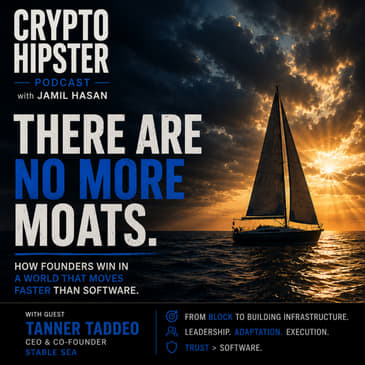

Tanner Taddeo, CEO and co-founder of Stable Sea, joins Jamil Hasan to discuss what it means to build a company when both technology and markets are changing at extraordinary speed.
Tanner shares the journey from Block to Stable Sea, why his team embraces constant experimentation, and why founders need to separate their self-worth from the products they create.
Then the conversation turns to a bigger question: Are there any real moats left?
As AI makes software easier to build and replicate, Tanner sees competitive advantage shifting toward speed, distribution, brand and trust—and believes human interaction itself may increasingly become a premium.
A conversation about stablecoins becomes a conversation about adaptation, leadership and building for the long term.
Crypto Hipster Podcast
Making sense of the digital economy—through the people building it.
[00:00:04] This is the Crypto Hipster Podcast. This is not a traditional interview show. These are perspective driven conversations with founders, builders and independent creators shaping what comes next.
[00:00:27] We go beyond headlines, beyond hype and beyond price to explore ownership, freedom and opportunity in the digital economy. Where builders talk freedom, not price. Hello and welcome to the Crypto Hipster Podcast. This is your host Jamil Hasan.
[00:00:53] Today's guest is Tanner Taddeo, CEO and co-founder of StableC. After working on cross-border payments at Block, Tanner set out to solve one of the practical challenges facing businesses using stablecoin technology, how to move money globally in ways that are faster, more efficient and easier to operate.
[00:01:17] Today we're going to spend less time on the technology itself and more time on the journey of building the company, making difficult decisions and what entrepreneurship teaches us about people. Tanner, welcome to the show today. Tanner Taddeo, Stable Sea, Thanks for having me. Excited for the conversation.
[00:01:37] You're very welcome. So let's start and I want to find out, you know, your path before Stable Sea. What problem kept bothering you enough to leave Block and build your own company? Yeah, so we, you know, the team, we're a team of eight now. And about five or six of us came from Block. So we were all working there and we were working on a decentralized payment protocol. And that business unit was called TBD.xyz.
[00:02:07] And so we really, that's like where our first foray into stablecoins and on-chain RWAs really took flight. And we learned a lot there. So like super appreciative to Block and all we learned. And then we saw ultimately there at the time that stablecoin infrastructure was really built for retail related use cases. And it wasn't really built for B2B use cases. And so this was like circa 2024, like Q4 2024.
[00:02:35] So it was still early days, even though it's only been like a year and a half, it feels like the entire industry has exploded in the last two years. But that was our central thesis that we thought more and more businesses were going to use stablecoins or tokenized RWAs in their day-to-day practices for operating a business. And so we thought we'd go out and build infrastructure to serve that, that demand. So we, yeah, so that was the original impetus.
[00:03:03] And then, you know, before that, I spent some time at Plaid, spent some time at a spin out of the Gates Foundation, which was called ModusBox. And we're focused on open source, real time payment systems for central banks and emerging markets. And then, yeah, I've been in the financial services space before that, operating, operating kind of around the world. So always been in and around financial services, always thought that entrepreneurship was like a path to take.
[00:03:31] It was just really being convicted on an idea and making sure the market timing was right to go out and give it a shot. Great. So I think what you just said just surprised me a little bit, because like I have a crypto portfolio and I never considered stablecoins being part of it. Like you said, stablecoins two years ago were primarily for retail. So I guess I have a misunderstanding or the market has a misunderstanding.
[00:04:01] You know, what's the traditional financial market misunderstanding about stablecoins? Yeah, I'm not sure it's even a misunderstanding more so than it is just to evolution. So, I mean, most of stablecoin, like the original purpose of stablecoin was really used and still is the majority of like stablecoin flows are used by like traders.
[00:04:24] So like it and mostly like institutional like crypto hedge funds or brokerage companies that need a stable peg to get into and out of to do high frequency trading. So that was like stablecoins original use case circa like 2017, 2018.
[00:04:40] But when you try and take stablecoins and move them into the real economy for just everyday spend or everyday utility, most of that, most of the fintechs that were built like in 2020, 2021, 2022, they're really using stablecoin for some sort of cross-border payment use case. Right. And that's like remittance was where product market fit was first found.
[00:05:07] So there's a lot of great companies out there that are stablecoin related fintech applications that help a user send money easily back home using stablecoins. And then the end recipient can kind of receive an USDC and hold in that currency as a hedge against, you know, its own currency volatility. So like that was use case one gig economy payouts, you know, number two payroll number three.
[00:05:33] So you really started to see this more like retail and by retail, I mean like high volume, low value transactions for stablecoin payments. Because like even if you're using a retail app for like buying crypto on Coinbase, you're probably not putting $2 million or like the average user is probably not moving $2 million a day into and out of Coinbase. Right. You're probably investing 200 bucks, 500 bucks, a thousand bucks, et cetera.
[00:06:02] So a lot of the infrastructure for stablecoin, meaning like how you on ramp into it, the gas fees that are associated with on train transactions, the liquidity needed to get out of a certain stablecoin position into a local currency like South African Rand. All of that infrastructure wasn't really built for large tickets. So the infrastructure was built for high volume, low value. And then it wasn't really built for low volume, high value transactions.
[00:06:32] And so that was like the thesis back in the day when we first started at StableC was how do we build out that like B2B infrastructure so businesses could participate in the use of stablecoins on chain RWS. So then you had to recognize that your customers had a lot of had a lot of pains. What convinced you that they had this this need and that there was a real business opportunity?
[00:07:00] I mean, other than the buzzwords stablecoin, you know, which is going through regulations right now, whatever. What made you decide, hey, hey, we got a problem here that we're going to solve? Yeah, I mean, you know, we saw it at Block when we were building some infrastructure over there that if you wanted to move large transactions, it was again, this is like Q4 2024. Just to put some timing around when we saw the problem, we saw it firsthand and like some of the products that we were building.
[00:07:28] And then we went out to the ecosystem and we asked, gosh, probably 30 different companies that all were building with stablecoin. And we said, hey, do you guys have an issue off ramping, like converting USDC or USDT in large values? So five, 10, 20 million dollars into local fiat currency. And the resounding answer at the time, almost unanimous was yes. Yes.
[00:07:56] And so that's not only did we see it and feel it in virtue of what we were building at the time, but also when we talked to the market, it was just a clear, clear as day pain point. The market has since solved that problem. Well, it still exists in some capacity, but yeah, that problem has since been relatively solved. So it was a good launching point for us though, back in 2024. Got it. So seven of you came over from Block.
[00:08:26] So you didn't have a problem finding co-founders, right? But what made you convince everybody to come along with you for this new opportunity and leave the Block behind? Yeah. Yeah. So we're a team of eight and five of us came over from Block. But yeah, it was less around convincing.
[00:08:49] I think we had all been building so closely to and with the market that we all saw the opportunity in front of us. And it was more or less like the conviction that what we saw, like when you're building a product, you know, you see things in the market because you're talking to the market every day. And you see things and when you're building and talking to the market on a daily basis, you have a general perception on like where the puck is going.
[00:09:19] And like you want to be skating to where like the puck is going to go to use like an ice hockey metaphor. And so I think all of us were so close to the market that we saw the trend lines. And then, you know, we were pretty convicted in the idea and that we all worked really well together. So it's kind of like a rarity that you find people that you work really well with and also really enjoy just personally and professionally spending time with.
[00:09:46] So it was a really good team, like team dynamic and working dynamic. So we said, hey, if we can go raise some money, why not take a bet on ourselves and go see what we can do? So it was less a convincing on the idea. It was more of a, hey, we actually really want to stay together and we really want to go work on this idea collectively. Can we go do it? I think it helps to have people on your side.
[00:10:15] So it makes things really easy, right? Yeah. So what challenges did you have in your first year? You know, what were the greatest challenges and the greatest things that you learned from that transition? Yeah, I mean, a number of things. I think, you know, the biggest challenge that we had was actually, it wasn't execution and it wasn't, you know, most founders operate with like, they struggle with like execution. They struggle with hiring. They struggle.
[00:10:45] There's all these different challenges that like one faces along the journey. We didn't have any of those. The interesting part for us was that the market, we've never been in a market that like shape shifts so much. And the market dynamic that we entered in, because we officially launched in February of 2025. And at the time there was like relatively nobody doing B2B off-ramp infrastructure.
[00:11:15] And so we launched in February and then like March, April, May, June, like every major company either made an acquisition or announced some sort of off-ramping product just about overnight. And then you had Genius Act that landed, you know, mid-summer last year. And Genius essentially laid the blueprint for how regulated financial institutions like banks could participate in the stablecoin ecosystem.
[00:11:42] And then you saw, you know, the emergence of like JP Morgan's, JP Morgan coin, you know, connects us with the blockchain and then Citi launched their Citi coin product. And so the bank started getting into it. The network started getting into the space. The large incumbents started getting into the space. And so, you know, there was a minute there kind of like mid-summer last year where it felt like being a mouse dancing amongst elephants.
[00:12:08] Where like we thought, but we were first past the post and then the market just shifted on us. And it's really interesting to be a David and Goliath story where you're like a tiny player. I mean, you know, we raised a handful of millions, which is good, but it pales in comparison to like the balance sheet of like a Coinbase or a Visa, you know.
[00:12:27] So it's like a, well, so that was like a real interesting learning of navigating the ship through market structure change, as well as navigating the ship through a time where just an absolute incredible amount of capital and focus just turned exactly on the pain point that you were trying to solve. And you're like, oh, that's, that's interesting. Yeah. And then October happened. Mm-hmm.
[00:12:57] And then you're all in market structure. How did you deal with, how did you deal with October and since? Yeah. And in terms of market, you mean clarity or in terms of October? The market tanked dramatically. Yeah. So we didn't, we didn't have that much exposure to like crypto assets, right? Like we didn't have like a crypto coins, like stable coin, like USDC has held its peg.
[00:13:26] Um, so there was no real, uh, decline in, there was no real effect, um, on stable coin usage side of the equation. Uh, what that did do though, is like, we are without question in a bear market at the moment for crypto kind of writ large. Um, you know, even for like Bitcoin, a lot of the, the compute that went into mining Bitcoin has now been reallocated to AI.
[00:13:50] So, um, a lot of, like a lot of energy and has been reallocated towards the AI boom. A lot of like stable coin companies or crypto companies have pivoted to become AI companies. Cause they think that like agentic bots are going to run on blockchain rails. You know, we can have that conversation. Um, but for, for us, it didn't really affect our day-to-day operations. Ultimately, like it just made the, the funding, like the VC funding in the space decline.
[00:14:17] So there's less like startups coming out that are looking for your underlying infrastructure. Um, so it, you know, for us, we already knew that our core thesis was, um, it was right in virtue of, uh, having off-ramping infrastructure be a big, big pinpoint. But with the amount of capital that was coming in coupled with like the, the addressable market that you can sell to shriveling up because the, uh, the VCs were, weren't funding that space as, uh, fervently as they were prior.
[00:14:47] You know, we had to evolve into a new thesis that we had, you know, high conviction on. So we took the winter to, to, um, essentially refocus the business and the product towards a new area of the market that we thought that there was, uh, you know, some significant pull from. And what was that process like? You don't have to give me the details if you don't want to, but I just want to find out what that, what that shifting, what that shifting process was because look, okay, you've done it successfully so far. Yeah.
[00:15:14] I mean, I, you know, it wasn't, it wasn't really painful. It wasn't really that painstaking to be honest. I think it's primarily because of the culture that we build here at Stable C where, you know, every week we tell like the team is small as eight people. So I think principally and philosophically in the new era of work that we're, we're entering into teams are going to be small.
[00:15:38] Like I, I'm not particularly convinced that we're going to live in a time where you've got 10,000, 20,000 person organizations anymore. Right. Like you did in the 1990s, 19 or the early two thousands, maybe in some manufacturing spots where you just need some like workers to build products. But even then you're not going to need a ton of people.
[00:15:57] So for us, when we started at Stable C, like the philosophy around organizational building or company building at the time was that every person in the team needs to understand holistically the system that we're building. And so that includes like down to the core infrastructure, how it's built, who we sell to, why we sell to the feedback that we get from the market. Like one person can't hold this information and then like disseminate it.
[00:16:24] We all need to collectively be looking at the system and then making improvements to it day in, day out. And as a result of that starting point, we're very transparent for like the folks that work with us internally. We're very transparent on where we're at, what's working, what's not working. And then we always set up monthly AB tests. And so we, you know, from a cultural perspective, like whatever you work on for a month, it may or may not exist next month.
[00:16:50] Right. So you could spend four weeks running really hard at a feature, a product, sort of client base in the market that you want to sell to. And after those four weeks, if we don't have enough data to be convicted that, hey, there's something here, we're going to sunset that feature, throw away that code, stop selling to that segment, segment of the market. So every month is an AB test. And then like once we get some signal, we double down. And so we think about it of like placing tiny bets all the time.
[00:17:17] And so as a result of that, that has allowed us to make really quick and acute adjustments to the business without folks feeling like they've been duped in some way. Right. Because like there's there's two components here that I think are really interesting. One is that if you're in a startup, like you have an idea or the team has an idea of what the thing is. But product at time A is going to be wildly different than product at time B.
[00:17:46] Right. Like look at any great company out there. Like the first idea of that company when they got pre-seed funding, seed funding is materially different from when they go IPO. So businesses morph and change. The idea is a living creature. And then the market that you're selling into, most people think of a market as like static of like, oh, it just exists and I'm going to go sell into it. No, the market is also alive because you've got regulation, you've got different participants, you've got different capital flows coming into and out of the space.
[00:18:15] So product market fit is an interesting one where like you have an idea and then you have a product. That product is changing and the market is also changing and you need to fit those two things together. And so the only way that you do that, like from zero to one, how you go from one to 10 is very different than going zero to one. But going zero to one, you have to be super nimble and you have to take a lot of small bets and a lot of shots on goal to see what is sticking in the market.
[00:18:42] And then second to that, you need to set your team up for success there because psychologically, just humans in general, you know, we like to see the fruits of our labor and we don't like to be inefficient with what we do with our time. And so, you know, most folks that hire in startups, they like to hire from big brands. You know, you want to come from like the best, like Google, Facebook, whatever it is.
[00:19:07] But in those companies, you have such structure and such order and such efficiency that you already know what you're going to be working on for the next six months. And it doesn't really deviate. You kind of do H1 planning or H2 planning and that's about it. But in a startup, you cannot think that what you're building Tuesday, August 4th is what the same thing you're going to be building Tuesday, September 4th. Right. It's going to change.
[00:19:33] But you also need to detach self-worth from the output of the product, which is like a very hard thing to do because a lot of people want to feel that when they produce something, it is them. You know, like there is some, yeah, there is some interconnection between people's expectation. They want to be proud of their work output.
[00:19:57] And if it's not used, it's somehow a negative reflection on the time that they worked on it. And that's like not the case. So in a startup where, sorry, this is a long-winded answer, but in a startup, it's very much like, at least for us, we make sure that like we're just taking a whole bunch of A-B tests and we're experimenting all the time. And if the experiment works, we'll keep it. And if it doesn't, we're going to throw it out. But if we throw it out, it doesn't mean that the work to get us there wasn't good.
[00:20:26] It just means that for whatever reason, our perception of what the assumption was in the market was wrong. And we need to go test something else. You said a lot of good things. I don't think it was long-winded at all. I have quite a few follow-ups. The first thing that stood out to me, though, is you're right. A lot of people have a hard time detaching their self-worth from the product they create. How can they do that?
[00:20:56] Yeah, that's a great question, honestly. You know, I think, yeah, it's not particularly an innate quality. I think it's more of a learned skill. So it's not a priori. It's more of a learned method. I think you need to set the team. Like if you're a leader of an organization or a team, you need to create the right environment for that, right?
[00:21:20] Because like if you cultivate that environment and you tell the team like, hey, we're going to fail 99.9% of the time. And our assumptions that we have today are going to be really wrong tomorrow. And you lead with that premise, then folks feel comfortable failing or folks feel comfortable throwing their work out. You know, it's like when you get lulled into this false sense of security that like the structure that you're operating in, whether it be a company or a team,
[00:21:50] when you just assume that it's going to work and you're going to get rewarded for that work and it doesn't work out, that's when like it starts to be, it starts to cause friction. And so it's really more of a cultural dynamic of like you need to set the tone from the outset that like, you know, and I say it all the time internally, to be honest, like I think it starts with leadership. But I'm the first one to say, I generally have no idea what I'm doing. And like, I definitely know that I know nothing at all.
[00:22:18] So like I have a bunch of assumptions, but it's not just me, it's the team because the team sees things that I can't see. You know, I'm typically the dumbest person in the room. And so like you want to like build a good team that's way smarter than you. And they bring different perspectives to the table and you look at it and you're like, okay, collectively, 51-49, we have X amount of resources that are finite in nature. Let's double down here for four to six weeks. And see if we see some sort of emerging signal. And then like when you start to, I think it just starts with leadership in that culture.
[00:22:48] If you build that culture, then people are okay to say, hey, even leadership is like super transparent. They recognize when they get assumptions wrong, we can be wrong in that too. And like, then you make people feel that we're on this journey together. And that's where I think you get that sense of culture. That's more of an emergent property than like a property that's innate in any like founding product or organization. Yeah.
[00:23:14] Took me a decade to try to, it took me, I think, I think, I think I'm there where you're at. Just take me a decade. So, you know. One of the things that I learned early on, and a lot of people do this, is they focus so much on revenue that they're building on top of quicksand. And when the quicksand shifts, the revenue leaves.
[00:23:37] You know, so you lean, which I've noticed as a pattern, but you're also building on top of this. In the US, we have, you know, the Clarity Act and people thought last week it was 72% likelihood of passing. Now it's like 27%. How do you continue to build on top of an environment that is quicksandish? Yeah. You know, I think, I think the quicksand, there's two things to call out there.
[00:24:06] I think the quicksand nature of markets, especially in the crypto world, really lends credence to startups. Like, I think if you're going to take a bet, it's better to bet on a startup in the crypto space than an incumbent. Just because the way in which AI is going, you know, there are no more moats anymore. If you want to say, oh, I've got the best team and I've figured out some bespoke integration that's going to take forever to build and I have the best API docs. All that stuff doesn't matter anymore.
[00:24:34] Like, it used to back in 2020, 2021, 2022. But now with AI, like, honestly, you can go with like Fable 5 or whatever model you use. You can really spin up APIs, quality API docs, build the integrations in under a month or two for whatever it is. So software is no longer defensible in the age of AI. And the only thing that a startup has and or an incumbent has is speed.
[00:25:02] That's the only thing that you have that can be a moat. And so you have to ship as fast as possible. And you have to be as nimble as you possibly can to survive in a quicksand-like market. Because there are no more moats. The only moats in, like, software space, like, set aside FinTech.
[00:25:20] But any industry that is using software, the only moats that exist today, you know, sans licensing for, like, in a regulatory environment like FinTech, is really just brand and then distribution. Do you have an existing set of customers that you can sell into? And is your brand trustworthy? Those moats, those are, like, actually pretty good moats. But they're not, they're temporal in nature, you know.
[00:25:48] And I think that that's something that, like, a lot of people working in tech, you know, you have to come to terms with that assumption that you're in a company. And that company is not going to be around for that long. I mean, look at some of the best companies back in the day. You had, like, Nokia. I mean, I guess Nokia is still around. But, like, is it Apple? No. You know, you had MySpace, which then fell by the wayside and Facebook took over.
[00:26:17] You know, you had Napster. And then Napster declined. And then Spotify came over. And these were, like, you know, hundreds of millions in revenue. These companies were making hundreds of millions in revenue. So if you're inside those companies, you think, oh, hey, great, we're making 50 million in revenue, 75 million in revenue, et cetera. And we're just going to continue to build the ship. And they had some sort of moat at the time. But the thing is, is, like, all moats are penetrable. And no moats last forever.
[00:26:46] Like, even in the Fortune 500, like, rarely do you have a company that has, like, stood the test of time. Like, 200-year-old companies, right? Like, even the Dutch East India Trading Company doesn't exist anymore. So all empires will fall. And then the question is, like, if you're building in a space that has a ton of, like, fast-moving parts, how do you do rapid A-B testing? How can you set up your culture to learn and experiment quickly?
[00:27:15] Because the only moat that you have is speed. And that speed is going to get you to either more customers or an exit opportunity really quickly. And that's ultimately, like, what most companies are building for, is either to, like, an exit outcome or they're building to build distribution really quickly and then hope that it can hold on to that distribution and the market doesn't get swept out, you know, underneath them really quickly. Wow. Okay.
[00:27:44] So let me see if I can get this right. Okay. I was, oh, by the way, do you know my background? No. A little bit, but share with us. AIG. Okay. You know, that failed. Spectacularly. Yeah. You know? Yeah. Well, you said a couple things there. You said that there were people there that hope, you said hope is a strategy and exit as a strategy.
[00:28:11] Say you're a company that you want to have be around for the long haul. And if software is becoming commoditized and AI makes features easier to copy, then what becomes the real competitive advantage? Yeah. I mean, it remains to be seen. I mean, this is obviously just speculation more so than a fact. But, you know, I think real competitive advantage is going to come down to brands.
[00:28:41] It's going to come down to like distribution. Like this was the one time in history where actually incumbents have a leg up over startups. Like if you have distribution already and you've got a thousand clients and then you can actually manage your company to go build products and services as fast as startups, you already have an install base to sell them into.
[00:29:00] So it's the first time where like incumbents, if they manage correctly, actually have a leg up over startups, which is completely antithetical to the Silicon Valley kind of history. And so like, you know, that that's where value goes. I also think value swings back to the humanities in a lot of ways. Like if you're building value added services with a human in the loop, that is somehow going to accrue more value than not.
[00:29:27] And like what are like what is the what's the argument for that? Like I don't know if you have a Chase Sapphire or like an Amex Platinum, but you pay, you know, 750, $850 for those in fees. And then what do you get in return outside of like the perks to buy some stuff on discount? You you get the ability to call your your credit card provider and a human picks up with within 60 seconds. Valuable Delta Airlines, right?
[00:29:55] If you have status on Delta Airlines, like what is what does it work? What does it mean to have significant status on Delta Airlines outside of like a free check bag? It's you can call Delta and get a human on the line within 60 seconds to help with your booking. So value added services are kind of swinging back to humans and humans are the premium at some point in time. So I think that value will swing back, you know, that way. And then I think manufacturing or like if you're building in hardware, there's a real moat around that.
[00:30:24] It's really tough to set up a supply chain, like just really difficult to do. And it's capital intensive takes a long time to establish those relationships. So I think value is going to shift away from software into different areas of the economy. But in the software space, value will still be accrued to folks that can ship quickly and have a distribution moat.
[00:30:48] So the incumbents are actually well set up, but let's see if they can move quick enough for distribution. The incumbents are set up well as long as they don't have misaligned incentives. Yeah, that's that's correct. That's correct. Yeah. Go ahead. No, I was going to say, yes, that is like if you were ever going to favor the incumbents over a startup historically,
[00:31:18] you would always favor the startups because they could move quicker, ship faster, you know, do all the things. And they could build distribution quicker because you'd take venture capital dollars, subsidize the price, undercut your competition and up and to the right you go. Nowadays, you know, for the first time ever, I think incumbents are probably 50-50 on who wins. Because if incumbents and those companies are managed correctly and the incentives are aligned, which is a big if,
[00:31:45] then you should theoretically be able to take product, stitch it together really quickly using like three engineers plus AI. And then you've already got an install base of customers to sell into. Right. Because the bottleneck for any startup is ultimately go to market. Like no longer does it take two years to build a product. Like you can build a product in like a month or a quarter at best. And then the question is, how do you actually sell that? And selling, you know, software in a highly regulated space like fintech or crypto, it takes time.
[00:32:16] And then it takes trust. And so time and trust are on the side of those with big balance sheets. Time and trust. It's, you know, not on the side of startups that have like limited capital in the bank. And you really need to grow exponentially, you know, month over month. So it'll be, it's an interesting time to be a builder. It's like, there's a paradox in this moment that we live where it's never been an easier time to be an entrepreneur. Like use, like vibe code your app.
[00:32:45] Use Fable 5 or Claude to build like some double entry ledger on the back end. Set up your architecture correctly. So it's never been easier to do that. But subsequently, it's never been a harder time to be an entrepreneur. Raising capital is more difficult. Go to market is more difficult. So it is, yeah, it's a unique time to be building in the age of AI and especially in crypto where like market structure is just waxing and waning all over the place. Yeah.
[00:33:13] You're building the long arc where everybody else is seeking a short term attention. Yep. That's exactly right. Okay. Say you build the long arc. Say your company's building the long arc. You know, what does success look like to you in five years? Yeah. I mean, we definitely are building the long arc. It's tough to take a long-term view when you take venture capital.
[00:33:42] There's just an inherent rocket fueling nature of venture capital that like once you get on that chutes and ladders game, you just got to keep playing chutes and ladders. But, you know, we're in it for the long term because like Stable C, we're a capital markets platform. So we're on-chain capital markets platform for businesses and fintechs to come. And if you have idle stable coin holdings, you can sweep in the SEC registered yield bearing products.
[00:34:07] And so, you know, our long-term thesis is that, you know, in 10 years, it's just a basic thought experiment. Like in 10 years, are more businesses going to move their capital on-chain or off-chain? And I think if you're in this space, the assumption is a relatively easy one. Like, yes, we assume that more capital in the real economy, in fintech, in AI companies, even if AI agents take off, like still a long way away from that.
[00:34:33] But like, even if that happens, like, will that be on a blockchain or will it not? And so for us, we believe that to be true. And then the question is, is like, how do you build differentiated financial services there? And for us, we believe providing access to registered SEC-related products on-chain is going to be an area where, you know, a lot of capital comes into.
[00:34:59] And so we're building for, like, success for us means that we have fintechs, we've got enterprises, we've got real economy businesses using Stable C to access SEC-registered products on-chain. So success for us ultimately is just making sure that we can, we get different folks from different sectors of the economy into the on-chain world. Because the underlying technology really shouldn't matter.
[00:35:26] It like, whether you're a Fortune 500 or you're a Web3 crypto company or you're a small business in Arizona, you should be able to access best-in-class financial services using the best-in-class technology. And so that's going to be a highlight or a hallmark marker of success for us. Yeah, that sounds good. Well, I have one last question. I want to thank you for everything so far today. And I have one last question.
[00:35:52] The easiest one is this, is how can people find out more information about Stable C and, you know, use your company as a client? How can they do that? Yeah, no, I appreciate that question. So StableC.com is where you can find us. The platform is free to sign up. But it's app.stablec.com to sign up. And then the real value adds is, you know, it takes about a day or two to get through KYB onboarding.
[00:36:18] And then after that, you've got access to a number of different asset managers and SEC-registered funds that typically generate around, you know, three and a half to four and a half percent APY. So you can start putting your money to work almost automatically. So that's about it. And then, of course, we're on Twitter and all the things. But, yeah, reach out on LinkedIn anytime. Awesome. Well, thank you very much for speaking to me today. I enjoyed the conversation. Yeah, absolutely. Thanks for having us.
[00:36:48] Thank you.