
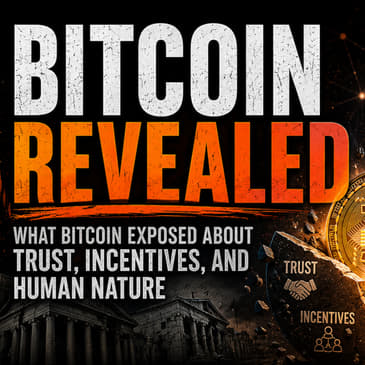

Most people think Bitcoin changed money.
I think Bitcoin revealed people.
In this solo episode, I reflect on nearly a decade inside the crypto industry and the lessons that emerged from hundreds of conversations with founders, builders, entrepreneurs, and creators.
What began as an exploration of Bitcoin ultimately became an exploration of trust, incentives, adaptation, and human nature.
Because the deeper I looked into technology, the more I found myself studying people.
The technology matters.
The people matter more.
[00:00:06] When most people hear the word Bitcoin, they think about money. Price, markets, speculation, volatility, headlines, charts moving up and down, recently down but mostly up through the years. For years that was the image presented to the public.
[00:00:32] Every bull market brought stories of overnight wealth. Every bear market brought stories of collapse, fear. Entire industries emerged around prediction, analysis, price targets, price targets and market narratives.
[00:00:59] But after nearly a decade inside this industry, I have come to believe that Bitcoin revealed something much more important than money. It revealed something about trust. About incentives. About systems.
[00:01:22] And perhaps most importantly, it revealed something about people. I did not arrive in crypto because I was searching for Bitcoin. I arrived because I was searching for answers.
[00:01:40] Now, years earlier. I'm not going to tell you how many years, but years earlier, I had spent my working career inside large institutions. Like many people, I grew up assuming certain systems were permanent. Certain companies felt permanent, especially when I started out at AIG.
[00:02:12] Certain financial structures felt permanent. Certain financial structures felt permanent. And I don't know, certain rules too. Then, you know, life. Life happened, right? Life has a way of reminding you that permanence is often an illusion.
[00:02:32] I lived through the financial crisis. I lived through the financial crisis. I lived through layoffs. I lived through watching institutions that once appeared unshakable. All aware. I lived through the financial crisis. So, A&M, a lot of people, layman, bear stearns, AIG, fail while all the countless others became very fragile.
[00:02:57] I lived through periods where certainty, certain T, felt, I don't know, so difficult to find. So when I first encountered Bitcoin, the summer of 2017, the technology itself was interesting.
[00:03:17] The idea of decentralized systems was fascinating to me. The possibility of coordinating people without traditional gatekeepers felt revolutionary, especially coming from a stiffy, stuffy corporate background.
[00:03:39] But what captured my attention most was not the technology. It was the question underneath the technology, which is what happens when trust breaks? And what happens when people attempt to rebuild trust?
[00:04:02] You know, for a lot of people, Bitcoin represented a new answer. I know it did for me. The promise was very simple. Remove intermediaries. Remove gatekeepers.
[00:04:18] It wasn't so much as remove banks. It was remove trusted third parties. Create systems that operate through rules that are not part of institutions.
[00:04:37] For, you know, for a generation that had witnessed repeated failures of trust across politics, media, finance, and, you know, countless other institutions.
[00:04:57] You know, that promise resonated deeply. You know, especially, you know, with me, it did. The idea that technology could create more transparent systems felt powerful. The idea that people could coordinate differently felt important. And the idea that incentives could be redesigned felt worth exploring.
[00:05:26] But then, you know, as things often, always do, something very, very interesting happened. The deeper I entered the industry, the less interested I became in Bitcoin itself. And the more I interested I became in the people surrounding it.
[00:05:53] Now, what began as curiosity eventually became nearly 594 guest conversations throughout the Crypto Hipster Podcast. 595, 596, something like that. Almost 600, not quite 600.
[00:06:14] Founders, entrepreneurs, developers, builders, creators, like me, right? Investors, community leaders, people from every corner of the digital economy. At first, I expected the conversations to, you know, to teach me about technology.
[00:06:40] Instead, they taught me more about human behavior than I ever asked for. The technology changed constantly, but the people did not. Those patterns did not. And everything in 2017, shortly after I got into Bitcoin, everybody talked about ICOs. And then I got into ICOs, right?
[00:07:09] Projects appeared daily. White papers, had to read those, 5,000 of them or so. Promises, new promises. People spoke about decentralization and disruption and transformation and entirely new economic systems. Then, you know, Crypto Winter happened. And then the cycle ended. And many projects disappeared.
[00:07:35] There are some stragglers and powerful ones that came out of the ICO days. You know, the Ethereum, the Chainlinks, a few and far between, right? Because many, many, many communities disappeared and many promises disappeared. And the technology continued. People remained, you know. But a few years later after that, NFTs exploded.
[00:08:03] Just when I was first starting my podcasting, NFTs took off like a jet rocket, right? And the narrative felt revolutionary. You know, the language changed and the promises changed. But like, and the same excitement came back that was there for the ICOs. The ICO excitement, NFT excitement were kind of the same thing.
[00:08:25] But once again, you know, beneath all the new vocabulary, there were familiar patterns. Hope. Fear. Greed. Belonging. Status. And NFTs, especially social status. Identity.
[00:08:54] A lot of identity work. The same human motivations that had existed long before blockchains ever happened, ever were invented. Then came DeFi, right? DeFi Summer was amazing. And AI. AI now, right? There's countless other ways of innovation.
[00:09:21] And every cycle introduced new technologies, new possibilities, new opportunities. And it also revealed something very consistent. Human beings, us, you, me, human beings, we continue to behave like human beings.
[00:09:49] We behave like machines. We behave humanly. And then that slowly changed how I viewed Bitcoin. So technology remained important. It's still important. It'll always be important. It always matters.
[00:10:11] But Bitcoin's greatest contribution may not have been technological at all. It may have been revelatory. Revelatory. Revealed something. Because Bitcoin revealed things that, you know, many of us prefer not to see.
[00:10:40] The first thing Bitcoin revealed was that trust and the need for trust never disappears. One of the most common descriptions of Bitcoin is that it is trustless. Technically speaking, there is truth in that.
[00:11:04] But practically speaking, practically, most people don't experience Bitcoin as trustless. Most people trust exchanges. Coinbase, Binance, Kraken. Most people trust wallets. Trezor, for example. Most people trust developers.
[00:11:35] Alex Mashinsky was a developer. To create a 5G. Most people trust media outlets. A lot of people watch their favorite news station. And they all have slanted different views, right? Most people trust influencers. I'm not going to name names, but I question why. Most people trust communities.
[00:12:04] They trust somebody. There's nobody who trusts nobody. Even me. Trust did not disappear. Just moved. And once I recognized that pattern, I began to see it everywhere. Everywhere. Not just in crypto, no. In business.
[00:12:33] In politics, especially. In media, especially too. In technology. And then the kicker. In everyday life. We constantly. As people. Create trust structures. Around us. Sometimes formal. Sometimes informal.
[00:13:03] Sometimes you can see them. Sometimes you can't. Sometimes visible. Sometimes invisible. But. They're always there. Bitcoin did not eliminate trust. But it did expose where trust was already operating. Now. That's the first thing. The second thing. Is. That Bitcoin revealed that incentives shape behavior.
[00:13:34] Far more. Than most people. Either realize or admit. Right. One of the lessons I. One of the. Well. It carried a lot of lessons. But one of the lessons I carried from. Corporate life into. Into crypto. Was observing how. Systems influence people. Most people wake up. Believing they are. Acting independently. Yet. Incentives. Quietly shaped behavior.
[00:14:04] Underneath. The surface. And people don't admit it. They won't admit it. But it influences. Influences corporate incentives. It influences politics. Hugely. I use a drama Trump term. Say hugely. Well there you go. A lot of incentives that you don't see. People see. People act upon. Social incentives. Algorithm. Algorithmic incentives.
[00:14:35] That's a. That's an area to navigate. I've been navigating that for a while. That is. You gotta be on your ball. Financial incentives are obvious. Right. So. When incentives change. Behavior. Often changes. Alongside it. Crypto. Became one of the clearest laboratories. For observing this phenomenon. In real time. 24-7. Public. Became.
[00:15:04] A lab. A worldwide. Open lab. Projects rewarded certain behaviors. Communities rewarded certain behaviors. So there are platforms. So there are markets. And. As we do. Humans. People. We. We adapted. Most of us. I kind of didn't. But hey.
[00:15:35] I'm adapting now. Not necessarily. The adaption. The adaptation. Wasn't necessarily. Because. Of dishonesty. Right. And it wasn't. Because of greed. But. Because. We naturally. Respond. To incentives. That. Lesson. Eventually. Became. Eventually. Became.
[00:16:05] One of the most important things. About my writing. Right. Systems matter. Structures matter. Incentives matter. Because they. Influence. Outcomes. Long. Before. Most people. Recognize. They are present. Bitcoin. Revealed. Revealed. Revealed. Revealed. Those forces. Like. More clearly. Than almost. Anything.
[00:16:35] Else. I've ever seen. Or encountered. Right. The third thing. Bitcoin revealed. Was probably. Most important. Right. Technology. Can't resolve. Or solve. Human nature. Technology. Technology. Can improve. Efficiency. It can. Transparency.
[00:17:04] It can. Improve. Coordination. Access. It can. New. Possibilities. I don't think. It can. Eliminate. It definitely. Can't. Eliminate. Ego. It can't. Eliminate. Tribalism. You have more. Tribalism. Now. Than before.
[00:17:34] It does not. Definitely. Does not. Eliminate. Status. Seeking. Or identity. And it does not. Eliminate. Belonging. Belonging. Those things. Those things. Travel with us. They travel. They're portable. Right. Everywhere. Into. Every company. Community. Government. Movement.
[00:18:04] Into. Every protocol. To every blockchain. We bring. Ourselves. Into. Every system. That we create. We do not do it. Independently. The tools. We use. Evolve. The developers. Constantly create. New tools.
[00:18:35] And a lot of them. Work really well. Or new methods. Such as. Account. Abstraction. Zero. Knowledge. Those are great tools. You know. As far as. Bitcoin is concerned. Lightning network. Right. You know. Human nature. Remains. Remarkably. Consistent.
[00:19:04] And over time. This realization. Changed how I appreciate. And how I do. And how I conduct. How I approach. My work. I became. Less interested. In narratives. You don't need to use. Corporate speaker. PR speak. To sound good. I don't care about hype. A lot out there. Who. Are marketing. For hype.
[00:19:34] I don't care about hypes. I strip the hype away. Right. I'm less interested in. I know prediction markets are hot. But I am. Less interested in predictions. And less interested. In predicting price. Price. Price targets. Don't matter. You know. I'm less interested. In knowing where markets are going to go next. I mean. They can go three places. Right.
[00:20:03] They can go up. They can go down. They can go sideways. Sideways. Where else you're going to go. I guess. Up down sideways. Up down sideways. It's one of those three. Right. So. But I did become fascinated by builders. People. Building. Stuff. Right. People who continue to show up.
[00:20:31] When all the attention disappears. The beginning. The people who like begin. Like begin. And then continue. To build. When the prices collapse. When we hit that winter. Right. People continue to solve problems. When headlines. Move. To the noise. Which I call the noise. Elsewhere. Which is noise. Who cares if. To me.
[00:21:01] I don't. I don't care. If somebody thinks about. Somebody else's opinion. Who cares about their. Somebody else's opinion. That's not news. That's. Hearsay. Right. So. I can. I care about the people. Who keep operating. When systems become stressed. Don't work. Those conversations. Those. Conversations. Standing in. No matter what. That. That.
[00:21:29] Taught me far more than any chart ever could. Because. Builders occupy. A unique. Space. They stand at the intersection of vision and reality. They confront incentives directly. They confront uncertainty. And. Human behavior. Directly. And through their experiences.
[00:22:00] There are broader patterns that become visible. So the longer I stayed in crypto. The more I realized that. I was no longer studying technology. I was studying. Adaptation. Trust. Resilience. Identity. Right. Right. I was studying how people respond. When the systems.
[00:22:29] Surrounding them. The question eventually became. Far more interesting. You know. To me. Than Bitcoin. Itself. Because. Technology. Will always. Continually. Evolve. We will evolve. Faster than Bitcoin. Bitcoin. I'm sure. Someone. Someone. Someday. Will create. The opportunity to. I don't know.
[00:22:58] Make a faster Bitcoin. Make better money. You know. Maybe. Break Bitcoin. Using quantum. It's possible. Right. Blockchains will evolve. AI. Will evolve. Right now. AI is looking like. It's evolving faster. Financial systems. Will. Continue. To evolve. Because people. Love money. Platforms. Will evolve. To keep up with that.
[00:23:29] Entire. Industries. Will. Evolve. But the deeper challenge. Remains remarkably similar. Right. How do people. Adapt. When the systems. Surrounding them. Change. How do people. People. Adapt. When systems. Change. Right. How do people. Maintain trust. How do we.
[00:23:58] Preserve meaning. Because we. We got to find meaning. In everything. Right. How do we. Navigate uncertainty. How do we. Continue to build. Those questions. Existed long. Before Bitcoin. And perhaps. The greatest thing. That Bitcoin revealed. Was not a new. Financial system. Not a new. Asset class. Not a new. Or new form of.
[00:24:28] Hardest money. On the planet. Which. It is. Sorry. Gold bugs. But it's true. But. But. It revealed a mirror. A mirror. That reflects. Our strengths. Our weaknesses. Our. Aspirations. Our. Fears. Our.
[00:24:58] Incentives. And. Our. Contradictions. That already. Existed. Long. Within. Our human. System. So. Bitcoin. Actually. Revealed. Many things. It. Revealed. Weaknesses. In financial. Structures.
[00:25:29] It. Revealed. Possibilities. For new. Ways. Of ownership. It. Revealed. New. Possibilities. To coordinate. Globally. It. Revealed. New. Possibilities. For how. To trust. But. After. Nearly. A decade. Of. You know. Conversations. Half. Half. A decade. Actually. Well. No. I've been here. Since 2017.
[00:25:59] So. Almost a decade. Wow. Tongue flies man. After a decade. Of conversations. Observations. And success. And. Failures. And. Getting my. Butt handed to me. You know. Bull markets. And bear markets. And. Hundreds of interviews. In the past half decade. Right. The most important thing. Bitcoin revealed to me. Was something. I don't know.
[00:26:28] Much simpler. Right. Right. Every system. Every system. Leads back to people. People. The technology matters. And the systems matter. Incentives matter. Right. People matter most. But in the end.
[00:26:56] People matter most. People. Are people. And that's the story I've been trying to understand. My whole life. My whole life.